
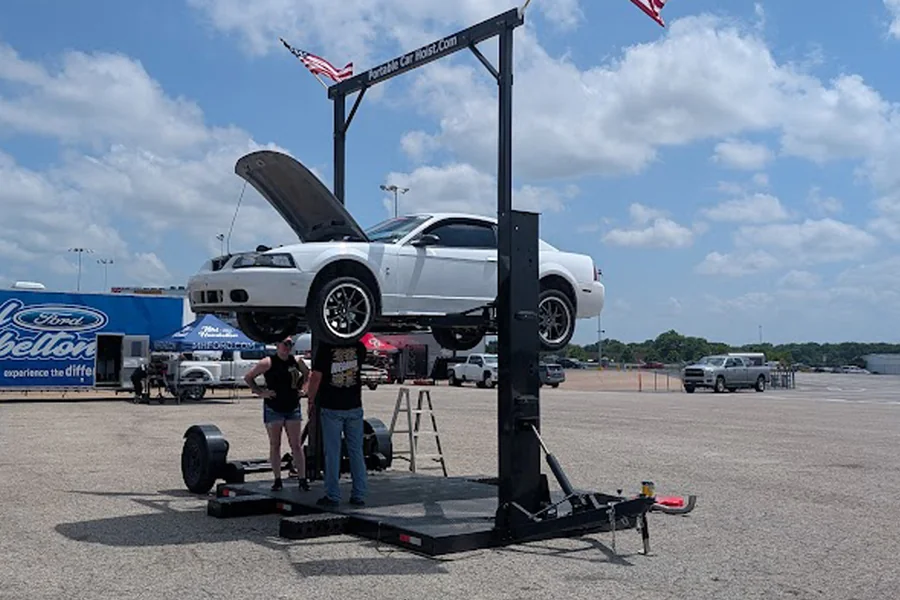
Across Canada, home mechanics and small shops make the most of the long summer days, and many now keep a scissor lift in the garage or wheel one onto a level driveway to raise a vehicle in minutes rather than crawling under it on a creeper.
The appeal of the portable version is that it never becomes part of the building. It arrives on wheels, works where you set it, and rolls away when the job is done, which is a very different proposition from a permanent post lift bolted to a foundation.
Wheels and a folding footprint let it travel to the car
A portable scissor lift is built to move to the work rather than wait for it. A pair of caster wheels and a set of lift handles let one person tilt the unit back and roll it across a shop floor, then lower it flat where the vehicle sits.
Because it rests on the surface instead of anchoring into it, there is no drilling, no expansion bolts, and no dedicated bay. The trade for that freedom is that the machine leans entirely on its own base and the floor beneath it for stability.
- Caster wheels: roll the unit between jobs
- Folding pads: collapse to a low profile
- No anchors: sets on the slab, not into it
Hydraulic pressure does the heavy raising
The muscle behind the platform is hydraulic. A pump forces fluid into cylinders, and because a confined liquid barely compresses, that pressure converts directly into a smooth, controlled push that raises the deck under a full six thousand pound load.
Height is held by a mechanical safety lock rather than by the fluid alone. Once the platform reaches a locking notch, a latch catches and carries the weight, so a scissor lift never asks the operator to trust hydraulic pressure to hold a car in place.
Lift points and the vehicle center of gravity decide stability
Where the rubber pads meet the underbody matters more than raw capacity. Vehicle makers mark reinforced pinch welds and frame points for exactly this, and the pads must land on those spots so the load feeds into structure that can take it.
The wider rule is balance. A scissor lift stays planted only when the vehicle center of gravity sits centered over the platform, so a truck with a heavy front engine needs its pads placed to keep the weight from tipping toward one end.
- Pinch welds: factory-marked contact points
- Balanced load: keep center of gravity centered
- Even pads: match height on both sides
A flat, solid floor is part of the machine
Since nothing bolts down, the ground carries the whole system, and a level concrete slab is really a component of the lift. A crack, a slope, or a soft patch lets the base rock, and any lean at the floor is magnified at the raised deck.
This is why a driveway needs a hard look before use. Asphalt softens in summer heat and gravel shifts under point loads, so operators reserve the raised work for solid, even concrete and keep the platform low while positioning the pads.
Understood this way, a portable scissor lift is less a fixed installation than a rolling tool that trusts sound hydraulics, honest lift points, and a level floor to raise a vehicle safely through a summer of driveway maintenance.