
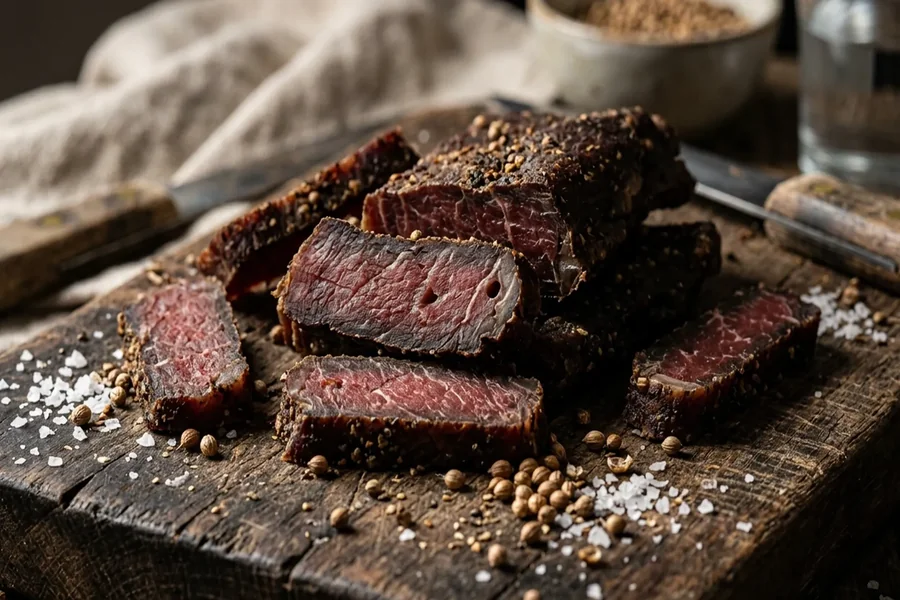
Most people choose their snack based on the packet, not the meat inside it. They grab whatever is closest to the checkout, chew through it without much thought, and move on. That works fine if you don’t care what you’re eating. It stops working the moment you actually want a good one.
The truth is that quality varies enormously between batches, brands, and even individual pieces cut from the same cure. Colour, thickness, and the way a strip bends in your hand all say something about how it was made and how it will taste. Once you know what to look for, you stop guessing and start choosing with intent.
This is where a properly cured biltong separates itself from the mass-produced stuff sitting under fluorescent lights. Good biltong is a product of patience rather than speed, and that patience shows in the final texture. If you want a reference point for what a well-made version should look and feel like, it helps to compare against a producer who treats the process as a craft rather than a shortcut.
The Cure Determines Everything
Long before flavour comes into play, the cure sets the ceiling on quality. A rushed cure leaves moisture trapped near the centre of the meat, which throws off both texture and shelf stability. A proper cure draws moisture out evenly, layer by layer, so the strip firms up from the outside in without turning leathery.
Vinegar, salt, and coriander are the usual suspects, but the ratio matters more than the ingredient list. Too much vinegar and the meat tastes sharp and thin. Too little salt and the curing process stalls, leaving a product that spoils faster than it should. None of this is visible on a label, which is why colour and texture become your best diagnostic tools at the point of purchase.
Colour Is a Clue, Not a Rule
A deep reddish-brown exterior with a slightly darker rim usually indicates a cure that had enough time to do its job properly. Pale, greyish patches can mean the meat was cut too thick for even drying, or that it spent time somewhere humid before packaging. Neither extreme is necessarily unsafe, but neither is a sign of care either.
Where colour gets tricky is with spiced or peppered varieties, where a heavy coating can mask what’s happening underneath. In those cases, colour tells you less than you’d like, and texture has to do the heavy lifting.
Texture Tells the Real Story
Bend a strip gently. It should flex without snapping cleanly in half, and it shouldn’t feel rubbery or damp to the touch. A strip that crumbles apart has likely been over-dried, often to extend shelf life at the expense of eating quality. One that feels tacky or soft in the middle probably wasn’t cured long enough.
| Cure Style | Typical Texture | Best Suited For |
| Wet cure | Soft, slightly springy | Those new to biltong who prefer a milder bite |
| Medium cure | Firm exterior, tender centre | Most everyday snacking |
| Dry cure | Dense, chewy throughout | Traditionalists who want maximum flavour concentration |
None of these styles is objectively better. The right one depends on personal preference and how the biltong will be eaten, whether that’s straight from the bag, sliced thin over a cheeseboard, or shaved into a salad.
Common Mistakes Home Curers Make
Anyone who has tried curing their own meat at home knows how unforgiving small errors can be. A few patterns show up again and again:
Cutting strips against the grain instead of with it, which changes how the fibres hold together during drying
Skipping the initial vinegar soak, which affects both flavour penetration and surface pH
Hanging strips too close together, restricting airflow and causing uneven drying
Storing finished biltong in an airtight container while it’s still slightly warm, trapping condensation
Commercial producers avoid these issues through consistent process control, which is one reason a trusted supplier tends to deliver a more reliable result than a first attempt at home curing.
Quick Reference: Good Sign vs Warning Sign
When you’re standing at a shelf or a market stall with limited time to decide, this side-by-side comparison is a faster way to judge quality than reading a label.
| What You Notice | Good Sign | Warning Sign |
| Surface colour | Even reddish-brown with a darker rim | Uniform pale grey or bright red throughout |
| Bend test | Flexes without snapping | Snaps cleanly or feels rubbery |
| Smell | Savoury, spiced, slightly tangy | Sour, ammonia-like, or overly perfumed |
| Surface moisture | Dry to the touch | Tacky, damp, or visibly wet |
| Consistency between strips | Minor natural variation | Identical, machine-perfect appearance |
Storage Guide by Cure Style
How you store a pack also depends on which cure style you’ve bought, since moisture content varies significantly between the three.
| Cure Style | Unopened Shelf Life | Once Opened |
| Wet cure | Shortest, refrigerate soon after purchase | Best eaten within a few days, keep chilled |
| Medium cure | Several weeks in a cool, dry place | One to two weeks refrigerated in a sealed container |
| Dry cure | Longest shelf stability | Several weeks refrigerated, freezes well for longer storage |
What This Means Next Time You’re Buying
Judging biltong properly takes about ten seconds once you know what you’re looking at. Check the colour for consistency rather than darkness alone, bend a piece to test flexibility, and be sceptical of anything that looks uniformly perfect, since real biltong shows small natural variations from strip to strip.
None of this requires special training. It just requires paying attention rather than treating the decision as an afterthought. The next time you’re standing in front of a shelf of options, use these cues rather than the packaging to make the call, and you’ll end up with something worth the price rather than something that merely fills a gap between meals.