
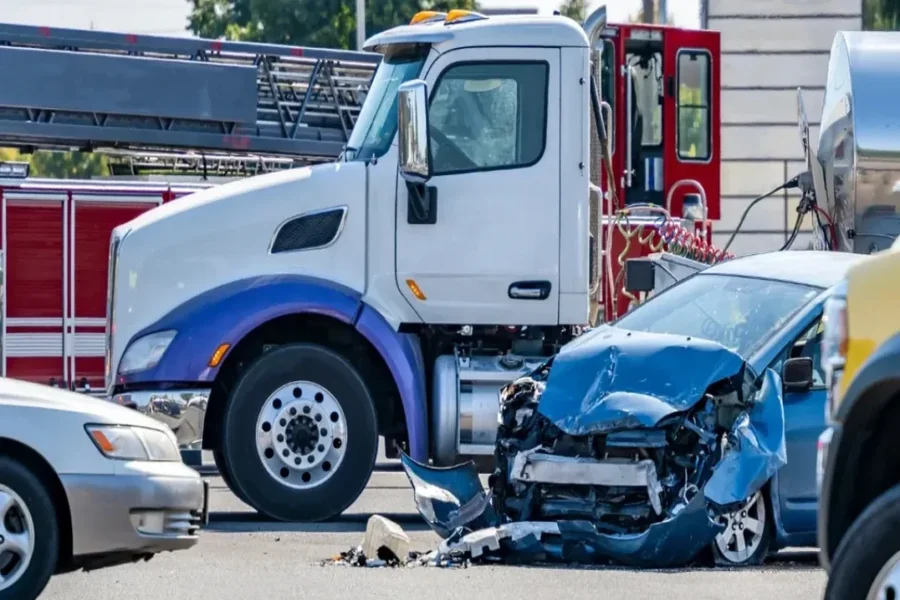
 You are probably dealing with more than a damaged vehicle. There may be medical bills, calls from insurance adjusters, missed work, pain that keeps you up at night, and the nagging sense that the trucking company already has a head start. That feeling is real. McNeese & Trotsky knows that truck accident claims move fast on the defense side, and the evidence that shows what really happened can disappear if no one acts quickly.
To prove negligence in a truck accident case, you need more than a police report and a repair estimate. You need facts that show who had a duty to act safely, how that duty was broken, how the crash happened, and how your injuries and losses flowed from it. In many cases, that means proving driver error, company failures, poor maintenance, cargo problems, or a mix of all four. A truck accident negligence claim often turns on records most people cannot access on their own.
Truck accident negligence depends on evidence, not assumptions
Negligence means someone failed to use reasonable care and caused harm. In a truck crash, that sounds simple until the trucking company starts pointing fingers. They may blame weather, traffic, your driving, or a sudden mechanical problem. You may know the truck drifted into your lane or ran a light, but knowing it and proving it are two different things.
The core proof usually comes down to four parts. The driver or company had a duty to operate the truck safely. That duty was breached through careless conduct or a safety violation. That breach caused the collision. You suffered actual damages, such as medical costs, lost income, pain, or long term disability.
What makes these cases different is the amount of evidence behind the truck itself. Commercial vehicles leave a paper trail and often a digital one. Driver logs, dispatch records, black box data, maintenance reports, inspection records, training files, drug and alcohol testing results, and load documents can all help show whether the crash was preventable.
Federal safety rules often expose how the crash happened
Many truck accident cases are built around violations of safety rules. A driver may have been on the road too long, a company may have skipped maintenance, or cargo may have been loaded in a way that made the truck unstable. Those facts matter because they show the crash was not random. It came from a preventable safety failure.
Public records can help identify warning signs. The Federal Motor Carrier Safety Administration keeps a system for checking company safety records, which may show prior violations, unsafe driving patterns, or maintenance issues. Crash data also matters. The National Highway Traffic Safety Administration publishes information through its Crash Investigation Sampling System, which helps illustrate how serious crashes are analyzed and what kinds of factors investigators examine.
If the driver was speeding, distracted, fatigued, impaired, poorly trained, or ignoring road conditions, that can support a commercial truck accident claim. If the company hired an unsafe driver, pushed unrealistic schedules, ignored inspection problems, or failed to supervise its fleet, the company may also be legally responsible.
The trucking company may be liable even when the driver made the mistake
One of the hardest parts for injured people is realizing that the case may involve several defendants. The driver is the obvious one, but the employer, maintenance contractor, cargo loader, or even a parts manufacturer may share blame. That matters because each party may hold different evidence, and each one may try to shift responsibility elsewhere.
Picture a driver who rear ends your car in stopped traffic. On the surface, that looks like simple inattention. Then records show the driver had been on duty longer than allowed, the brakes had prior repair issues, and dispatch messages pushed an unrealistic delivery window. The case changes. It is no longer just about one bad moment. It becomes a chain of decisions that set the crash in motion.
Early action protects the proof in a truck accident injury case
Some of the strongest evidence does not last. Electronic logging data can be overwritten. Video footage may be erased. Skid marks fade. Vehicles get repaired. Witnesses forget details. You may still be in treatment and trying to get through the week, but delay helps the other side more than it helps you.
A personal injury lawyer can send preservation notices, demand key records, review the crash report, work with reconstruction experts, and identify every source of insurance coverage. That is often the difference between a claim built on guesses and one built on hard proof.
Handling the case alone creates avoidable risks
| Issue | Handling It Alone | Working With a Personal Injury Lawyer |
|---|---|---|
| Access to evidence | Limited access to black box data, driver logs, and internal company records | Formal requests and legal steps can secure records before they disappear |
| Liability analysis | Focus often stays only on the driver | Can identify company, maintenance, cargo, and third party fault |
| Insurance tactics | Adjusters may push quick statements and low offers | Communication can be controlled and claims valued more fully |
| Damage calculation | Future care, lost earning capacity, and pain may be undervalued | Medical and financial losses can be documented in full |
| Case timing | Deadlines and preservation issues are easy to miss | Critical deadlines and evidence requests can be handled early |
Three steps you can take right away after a truck crash
- Preserve everything connected to the crash. Keep photos, videos, the police report number, medical records, repair estimates, towing receipts, and names of witnesses. Save texts, emails, and voicemails from insurers. Start a simple journal that tracks pain, appointments, missed work, and the ways your injuries affect daily life.
- Get medical care and follow through. Gaps in treatment give the defense room to argue that you were not seriously hurt. If you are in pain, dizzy, numb, anxious, or struggling to sleep, say so. Your records should reflect what your body is actually going through.
- Speak with a lawyer before giving detailed statements. A recorded statement can sound harmless, but wording matters. A lawyer can help protect key evidence, identify all liable parties, and build the proof needed for a strong negligence case.
Strong proof gives your claim a fair chance
You do not need to figure out every legal issue while you are trying to heal. You do need to understand that proving fault in a truck crash takes real evidence, fast action, and a clear theory of what went wrong. How to prove negligence in a truck accident case comes down to showing that the crash was preventable and tying that failure to the harm you are living with now.
If you were hurt in a truck wreck, a personal injury lawyer can help protect the evidence, deal with the insurance company, and pursue the full value of your claim.