
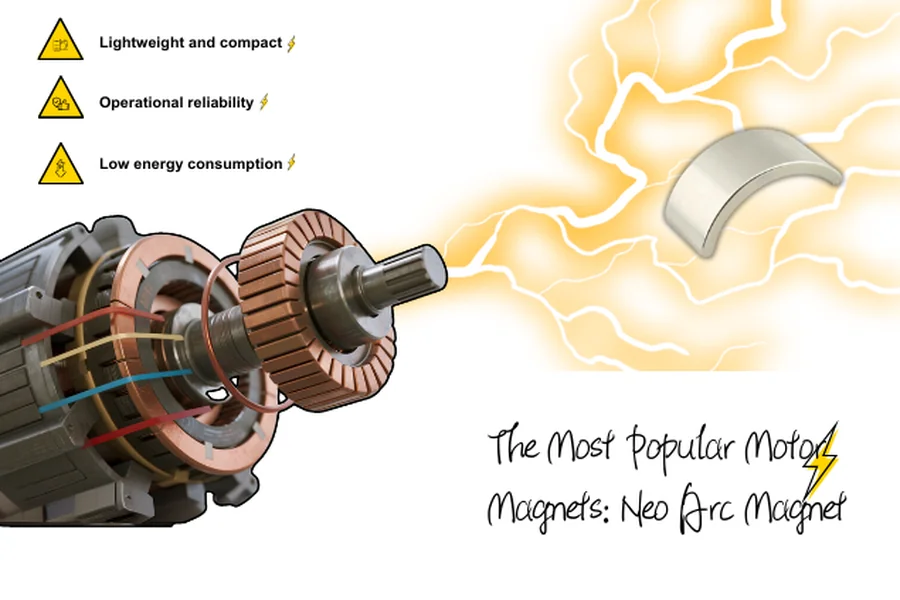
Neodymium curved magnets form the basis of modern permanent magnet motors, which are very operationally-oriented and have become popular due to their relatively cheap prices and a broad field of applications. The leading magnetic energy product offers the possibility of designing high-performance motors that take advantage of new parameters, both in comparison with other traditional materials like ferrites or alnico magnets.
Thermal Stability of NdFeB Magnets
In addition, compared to other permanent magnets, NdFeB ones have a substantially lower Curie temperature of about 310-400°C, at which the material loses its magnetization. That criterion implies higher susceptibility to demagnetization at elevated temperatures. Magnetic losses can be minimized if a given grade of the magnet is selected, depending on the maximum operating temperature of the motor, which is usually verified through accelerated aging tests simulating prolonged high-temperature exposure. Inclusions of the latest formulations, like those involving dysprosium, enhance thermal stability when the cost increases, creating a balance between performance and budget.
Chemical Stability and Corrosion Resistance
Chemical stability is definitely one of the NdFeB magnet features. Indeed, these magnets are very sensitive to oxidation. In this respect, NdFeB magnets clearly contrast with ferrite and SmCo ones, which hardly ever corrode. During sintering, cobalt, nickel, aluminum, or chromium are added as alloying elements to increase the material’s density and minimize porosity, enhancing environmental corrosion resistance. Above all, surface treatment, such as nickel-copper-nickel plating, epoxy coating, and zinc plating, would tend to act as barriers to moisture and corrosive elements.
Temporal Stability for Long-Term Performance
Temporal stability is the length of time an NdFeB magnet retains its magnetic properties under the given conditions. Magnet manufacturer add elements like Co, Dy, and Nb to increase the resistance to gradual demagnetization. Temporal stability is evaluated by long-term aging tests in which magnets are aged at a set temperature, and any change in the magnetic flux density is recorded.
Magnetic Stability and External Influences
The stability of the NdFeB magnets regarding magnetization is a complicated function of time, temperature, external magnetic fields, chemical corrosion, radiation, and mechanical stress. A strong external magnetic field emanating from nearby harnessed electromagnets or other permanent magnet motors partially demagnetizes NdFeB magnets in operation near their coercivity limit. Under all such circumstances, good engineering design practices dictate that motor systems should be adequately shielded. For harsh environments, the electronic engineer selects readily available magnet grades with a high intrinsic coercivity. During this design phase, finite element analysis (FEA) simulations will usually attempt to predict such risks and their mitigation.
Advantages of Curved Magnets in Motor Design
NdFeB curved magnets have several important advantages for use in permanent magnet motor applications: a simple construction; easy maintenance; light weight and compactness; great operational reliability; low energy consumption, etc.
These are the reasons why modern motor design often utilizes NdFeB curved magnets in pursuit of optimum performance vis-à-vis available engineering.
Lightweight and Compact: The high magnetic energy density enables small and lightweight motors yielding equal or better power output.
Operational Reliability: Stable magnetic properties contribute to stable operation and affect downtimes hardly at all in such crucial branches of motor use as industrial automation.
Low Energy Consumption: High efficiency realized in very low energy losses gives these motors a perfect choice for applications where energy saving is of the utmost importance.
All the above reasons make NdFeB curved magnets an attractive option for modern motor design, balancing practical engineering performance.
Motor Magnet Material Selection
The material choice shall be within the performance requirements of the motor and its operating conditions. An AC motor will use ferrite or alnico magnets because, in most cases, the price and performance make them attractive for low-power applications. On the other hand, high-powered motors use neodymium iron boron and samarium cobalt magnets since they have the best materials for the highest magnetic energy product. Samarium cobalt magnets are also available in situations requiring high-temperature stability, although their magnetic strength is less compared to that of neodymium iron boron magnets. Depending on the kind of cost-benefit analysis and application-specific testing, selection will be made to ensure performance within a given budget.