
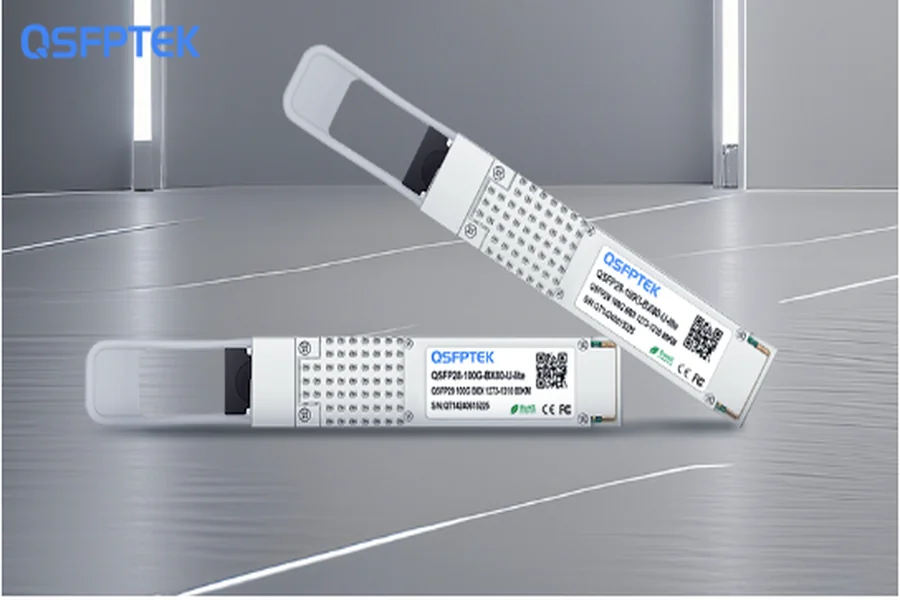
A Different Kind of 100G Upgrade Story
Most articles talk about 100G upgrades as if they were purely technical decisions. You pick a speed, match a port, plug in the module, and everything just scales. In reality, long-distance 100G deployment is rarely that simple. Once you move beyond the 10 km or 40 km range, the conversation shifts from bandwidth to fiber availability, recurring costs, fault tolerance, and how much operational complexity your team can actually handle.
This is exactly where the 100G BiDi ZR4 80km module starts to make sense—not as a showcase of raw optical engineering, but as a practical response to messy, real-world constraints. It’s built for long reach, yes. But more importantly, it’s built for networks where fiber is limited, expansion is expensive, and every deployment decision is tied to long-term operating cost.
Why “ZR4 + BiDi” Is an Unusual but Powerful Combination
Traditionally, “ZR” optics and “BiDi” optics lived in different conversations. ZR-class modules focus on reach and optical power. BiDi focuses on saving fiber by using different wavelengths for transmit and receive on a single strand. Putting these two ideas together creates something very specific: long-haul-class distance with single-fiber efficiency.
A 100G BiDi ZR4 80km module is not about squeezing the last bit of performance out of a short link. It is about solving a structural problem in networks where adding new fiber is not easy—or flat-out impossible. Municipal fiber routes, leased long-distance dark fiber, cross-river or cross-mountain paths, and heavily regulated infrastructure corridors all fall into this category.
In these environments, doubling the fiber count for a standard dual-fiber 100G link is often more painful than upgrading the optics themselves. BiDi ZR4 avoids that by design.
Planning Networks Where Fiber Is the Real Bottleneck
In many metro and regional networks, fiber planning was done years ago—sometimes decades ago—based on traffic models that no longer resemble today’s reality. What once carried a handful of 1G links is now expected to move massive volumes of cloud traffic, streaming data, and enterprise workloads.
When those legacy routes start hitting capacity limits, operators face two bad options: dig new fiber routes (expensive and slow) or squeeze more capacity out of what already exists. This is where a long-reach BiDi 100G solution becomes extremely attractive.
With a single fiber pair, a standard dual-fiber 100G design gives you one 100G circuit. With BiDi ZR4, that same fiber infrastructure can potentially carry two independent 100G paths, instantly doubling usable capacity without touching the ground.
From a planning perspective, that flexibility is hard to overstate.
How It Fits Between Traditional Optics and Coherent Transport
The networking world is currently fascinated with coherent ZR and ZR+ optics. They can push 400G and even 800G over long distances using advanced modulation and DSP. No question, they are powerful. But they also come with higher cost, higher power draw, and a steeper operational learning curve.
The 100G BiDi ZR4 80km module sits in a quieter middle ground. It doesn’t try to compete with coherent systems on ultimate reach or spectral efficiency. Instead, it focuses on predictable 100G performance, familiar QSFP28 integration, and fiber efficiency.
For many networks, especially those already standardized on 100G switching platforms, this middle ground is exactly what they need. It allows long-distance 100G transport without forcing a full shift into coherent transport architecture.
Operational Reality: What Engineers Actually Care About
From an engineering operations point of view, the biggest appeal of BiDi ZR4 is not theoretical performance—it’s predictability. These modules behave like standard 100G ports. They show up in monitoring systems the same way. They follow the same alarm patterns. They don’t require deep optical tuning or coherent parameter adjustments.
There is, however, one added operational responsibility: pairing discipline. Because BiDi relies on complementary wavelengths, the correct A-side and B-side modules must always be matched. In well-documented networks, this is manageable. In poorly documented ones, it can become a source of painful troubleshooting.
Still, once the link is established, the day-to-day experience is surprisingly ordinary. And in networking, “ordinary” often means stable.
Power, Cooling, and Rack-Level Constraints
An 80 km optical module will never be a low-power device. That’s simply physics. Amplification and higher output power require energy. Compared with short-reach LR or ER modules, BiDi ZR4 draws noticeably more power per port.
But here again, the QSFP28 form factor keeps things inside familiar thermal envelopes. Most modern data center and telecom-grade switches are designed to handle this class of module without exotic cooling solutions. As long as airflow is clean and consistent, these links can operate for years without thermal drama.
This matters because not every site hosting long-distance links is a pristine, purpose-built data center. Many metro nodes and regional hubs live in less-than-perfect physical environments. Equipment that tolerates those realities has a real advantage.
The Cost Conversation Nobody Likes to Admit
On paper, BiDi ZR4 modules are not cheap. They cost significantly more than standard LR4 or ER4 100G optics. But focusing only on module cost misses the real economic picture.
Fiber construction, fiber leasing, right-of-way permits, and long-term maintenance costs often dwarf the price of optics. If a BiDi ZR4 deployment allows an operator to avoid building just one new fiber route, the optics pay for themselves many times over.
In that sense, these modules are less about saving money and more about avoiding runaway infrastructure expenses.
Where 100G BiDi ZR4 80km Makes the Most Sense
This type of module finds its natural home in:
Metro aggregation networks
Inter-city enterprise backbone connections
Disaster recovery links between distant data centers
ISP regional core and access convergence
Public infrastructure networks with strict physical constraints
These are not environments driven purely by speed race metrics. They are driven by availability, redundancy, fiber efficiency, and predictable operating behavior.
Conclusion
The 100G BiDi ZR4 80km module is not the flashiest optic on the market, and it isn’t trying to be. Its real value lies in how it quietly solves problems that are difficult, expensive, and often outside the scope of traditional network upgrades. By combining long-reach ZR-class performance with BiDi single-fiber efficiency, it gives operators a way to stretch both their bandwidth and their physical infrastructure much further than before.
In networks where fiber is precious and long-distance 100G is no longer optional, this type of module often becomes less of a luxury and more of a necessity.